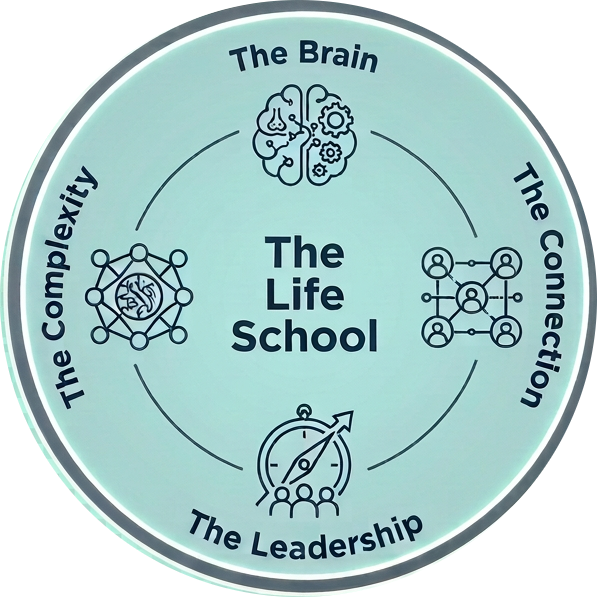
The Life School — Manifesto
Why I’m building this
I’m a corporate leader. Father of four. And I need to say something that costs me to admit: The system I succeeded in is broken. My children are sitting in classrooms right now, learning the exact playbook that will give them a crisis in their 40s.
Here’s what I see: My kids come home with grades. Good grades mean success. Success means love. That’s what they’ve learned.
Except here’s what 85 years of Harvard research actually shows: the quality of your relationships at age 50 predicts your health at 80 better than your cholesterol levels.[1]
Not your job title. Not your salary. Not how well you performed in school. Your connections.
The lie we tell 18-year-olds:
“You can’t start with purpose. First, survive. Perform. Make a good living. Purpose comes later.”
So they defer the thing that actually matters. They spend two decades building a life on metrics that don’t measure what makes life worth living. And then, if they’re lucky, they spend their 40s reverse-engineering meaning into a structure built on deferral. 10-20% of accomplished adults report experiencing a midlife purpose crisis.[2] That’s not a bug. That’s the system working exactly as designed.
The world they’re inheriting is nothing like the one these systems were designed for.
It’s digital. Unpredictable. Increasingly unstable. What teenagers need now is adaptability. Resilience. The capacity to navigate complexity without losing themselves. And the foundation of all of that? Connection. Not individualism. Not performance metrics. Not the ability to outcompete your peers. The ability to build relationships. To collaborate. To create meaning with others. But that’s not what schools teach. That’s not what gets graded. That’s not what corporate ladders reward.
l had to unlearn this as a leader: That my worth was tied to my output. That success was something I achieved alone. That happiness was the reward for winning. I learned all of these believes at young age. We all did. The same lessons my four children are absorbing right now.
Another way
This is why The Life School exists. Because there’s another way.
We can teach teenagers the components of happiness and satisfaction from the start. Not as something to bolt on at 40. Not as a luxury for people who’ve already “made it.” As the foundation. Purpose and income. Connection and contribution. Meaning and sustainability. Not a choice. Not a detour. The whole picture, integrated from day one.

We are building a lighthouse.
Not for people who’ve already succeeded and are searching for meaning. For teenagers. Before they take the detour. Because the world doesn’t need more leaders who hit 40 and realize they optimized for the wrong thing. It needs leaders who knew from the beginning: Happiness comes from human connection, not from achievement alone. That’s not a nice idea. That’s 85 years of data.
Who I need
Let’s build this together
- Parents — who are questioning the grind. Who see their kids grinding for grades and wonder if there’s a better way.
- Educators — who feel trapped by a system that measures the wrong things. Who know what students actually need but can’t teach it within the constraints they face.
- Leaders — who’ve lived the 40s crisis. Who climbed the ladder only to realize it was leaning against the wrong wall. Who want to save the next generation from the same detour.
- Researchers and scientists — with evidence. Who’ve published the studies proving what we already suspect: connection matters more than achievement, relationships predict happiness better than success, purpose integrated early prevents crises later.
- Entrepreneurs and designers — who can help us build the infrastructure. Curriculum. Experiences. Platforms. The actual delivery mechanism for a 6-year learning journey.
- Teenagers as co-creators. — Not just recipients of this curriculum, but partners in shaping it. You know what you need better than we do.
References
[1]: Mineo, L. (2017). “Good genes are nice, but joy is better.” Harvard Gazette.
[3]: UCL News (2026). “High academic pressure linked to teen depression and self-harm risk.”
[4]: Zhao, J., et al. (2023). “Academic Pressure and Adolescent Loneliness.” Psychology Research and Behavior Management.
[2]: “Midlife Crisis: Symptoms, Causes, and Coping.” HelpGuide.org.
 The Life School